ESTADOS UNIDOS

-
ARGENTINA

-
BRASIL

-
MÉXICO

-
CHILE

-
COLOMBIA

-
PERÚ

-


Latest posts

30 de July de 2025
Share:



Florencia
AV & Collaboration Specialist
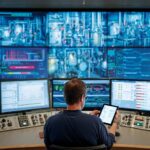
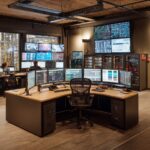
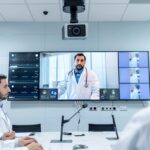
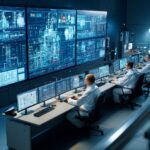
In sectors such as the energy industry and the mining, where margins for error are minimal and response speed is decisive, the industrial collaboration space has become fundamental components to ensure operational continuity. However, not all these spaces serve the same function or meet the same technological requirements. Knowing the differences between a crisis room, a collaboration space and a monitoring center not only allows you to better leverage existing infrastructure but also ensures an effective response to any operational or strategic incident. Each type of space demands a specific integration of audiovisual systems and data platforms to ensure smooth communication, contextualized and aimed at agile decision-making. In this context, technologies such as the Internet of Things (IoT) and artificial intelligence are transforming how decisions are made. But this digital transformation is only effective if the spaces where information is centralized are correctly designed from the outset. In many organizations, the terms monitoring center and control room are used interchangeably. Both refer to a physical or hybrid space from which critical operational systems are monitored, such as: The main function of this industrial collaboration space is to enable real-time control, so teams can make technical decisions without stopping the operation "The goal of the control center lies more in the monitoring and supervision of 24/7 operations," highlights Christian Rodríguez, Pre-Sales Technical Specialist at Newtech Group. For this, a high-availability infrastructure is required, which includes: At the data level, tools such as: The correct integration of audio, video, and data is essential to achieve a unified, real-time view of the entire operational process. This type of space is especially suitable for refineries, processing plants, or facilities where an immediate response and maximum availability are required to avoid interruptions. Unlike the control center, a crisis room does not operate continuously. It is designed to activate during critical emergencies, such as severe incidents, external threats, or complex situations that require rapid strategic decisions. "It responds to and manages emergencies and incidents. It does not need to operate 24/7; rather, it is on standby to react," explained Rodríguez. In these spaces, multidisciplinary teams often participate: operations managers, security, executive management, legal, and institutional communications. Technologically, they must be prepared to facilitate real-time collaborative coordination, with solutions such as: On the audiovisual level, specific technologies are incorporated, such as: Data flow in these rooms usually prioritizes secure, isolated channels, with the aim of reducing cybersecurity risks. Differentiating these spaces from the project's initial design is key. This way, planning errors, ambiguities during critical moments, and installation of unsuitable hardware are avoided. The advanced integration of videoconferencing, shared visualization, and reliable data channels is what enables coordinated and efficient decision-making under pressure. The third type of industrial collaboration space is the industrial collaboration or training room, focused on facilitating knowledge transfer, technical team problem-solving, or corporate development. Unlike the other two spaces, here the focus is on fluid interaction and group work. This type of room includes: The acoustic design is optimized to achieve zone-based intelligibility, allowing the space to be divided into work groups without cross-interference. The data network is usually connected to LMS platforms (learning management systems) or internal solutions, with the aim of improving industrial collaboration both onsite and remote. The combination of audiovisual equipment and connected platforms facilitates an agile, scalable, and efficient interaction, key in environments where technical training and operational industrial collaboration are priorities. Not all companies need a standalone crisis room: "If the company regularly faces complex or crisis situations, ideally you would have a dedicated room," the expert added. And he added: "If high-level decisions must be made in an emergency without interrupting operations, physical separation is almost essential." Conversely, in more localized or technical operations, crisis functionality can be integrated within the control center, provided there are clear activation protocols and well-defined segmentation. The decision depends on multiple variables: from the level of incident exposure to the logistical characteristics of each site. The most important thing is that, whether in a single space or in separate rooms, availability, security, and fluid coordination are ensured when they are needed most. Want to see how these spaces are designed and operated in practice? We invite you to watch the full webinar on intelligent control centers in the energy industry. You will discover concrete cases, applied technologies, and keys to scaling operational supervision with robust and collaborative solutions. Typologies of Industrial Collaboration Space
Monitoring Center
Crisis Room

Industrial Collaboration or Training Room
When is it advisable to integrate or separate these spaces?
Share

If you are looking for advice on technological solutions
in videoconferences please write us!
"*" indicates required fields
© 2026 All rights reserved | newtechgroup.com