Last Updated: June 10, 2026
In an increasingly connected world, voice and video communication has become the backbone of remote collaboration. In this Complete Guide to Video Conferencing in 2026: Platforms, Rooms, and More, we will explore everything from the origins and what video conferencing is to the most technical details of audiovisual equipment, room design, and unified communications.
Throughout this guide, you will discover updated statistics, real-world use cases, hardware recommendations, strategic links to our services, and everything needed for your organization to not only implement video solutions but to leverage them to the fullest. Ready to take your virtual meetings to the next level? Let's dive in!
The Complete Guide to Video Conferencing in 2026: Platforms, Rooms, and More is your definitive resource to understanding not only what a video conference is, but also how to design spaces, choose systems, and ensure seamless interoperability. With the acceleration of the post-pandemic digital era, video conferencing evolved from being a technological "extra" into a strategic necessity.
This section presents:
- History and evolution.
- Adoption trends in enterprises and SMBs.
- Main technical challenges (latency, bandwidth).
Additionally, you will find direct links to specialized sections of Newtech Group:
Origin and evolution of video conferencing
Although video conferencing dates back to Bell Labs experiments in the 1960s, its mass adoption arrived with broadband internet. In 2026, we are talking about platforms based on advanced codecs and cloud architectures, which enable:
- 4K high-definition streaming without buffering.
- Artificial intelligence for face tracking.
- Integration with workflows (CRM, ERP).
Ultimately, we moved from pixelated screens to immersive experiences where virtual meetings feel just as natural as face-to-face ones.
Business benefits of video conferencing
Investing in video conferencing in 2026 is not an expense; it is a ROI-friendly decision.
- Cost savings: 30% reduction in travel and accommodation expenses.
- Productivity increase: meetings are 25% shorter thanks to collaborative tools.
- Improved engagement: visual connection strengthens corporate culture.
Did you know that companies with modern video infrastructures report 40% less absenteeism? Yes, investing in good technology directly impacts your team.
Cost savings and carbon footprint
Video conferencing eliminates unnecessary travel. According to 2025 data:
- A single global weekly meeting saves up to 1.2 metric tons of CO₂ per participant.
- Average corporate travel costs: $1,200 per person; with video, that figure drops to $0.
These numbers not only improve the P&L but also reinforce your ESG commitment, a key point for investors and stakeholders nowadays.
Essential features of video conferencing
For a meeting to be truly effective, you must consider:
- Real-time audio and video transmission without interruptions.
- Multi-device compatibility: mobiles, tablets, laptops, dedicated rooms.
- Intuitive interface and WCAG 2.1 accessibility.
- Security: end-to-end encryption (SRTP, DTLS).
These video conferencing features guarantee that any user, regardless of their technical expertise, can join without setbacks.
Real-time audio and video transmission
Nothing ruins a meeting more than lag between audio and video. Thanks to codecs like AV1 and H.265, in 2026 we can achieve:
- Latencies below 50 ms.
- Automatic reconnection in case of network jitter.
- Audio beamforming to prioritize active voices.
All this translates into natural interactions, as if you were in the same room.
Video conferencing modalities
There are several formats adapted according to the number of participants and purpose:
- Point-to-point (2 participants).
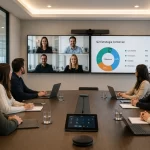
- Multipoint or group (3–50+ participants).
- Webinars and hybrid events (massive guests and simultaneous audience).
Each modality has its own requirements for bandwidth, licensing, and hardware.
Point-to-point video conferencing
Ideal for interviews, one-on-one coaching, or personalized sales.
- Requires a minimum of 1 Mbps upload/download.
- Usually used with USB 2.0 cameras or video bars on desktops.
- Allows screen and file sharing without the need for dedicated MCUs.
Essential equipment for video conferencing
Technology makes the difference. The basic elements of video conferencing equipment and modern meetings include:
| Device |
Primary use |
2026 Recommendation |
| 4K PTZ Camera |
Automatic speaker tracking |
Logitech Rally PTZ Pro |
| All-in-one video bar |
Huddle rooms and medium spaces |
Cisco Webex Room Bar |
| Beamforming microphone |
Group meetings |
Shure MXA 910 |
| 21:9 Interactive display |
Presentations and digital whiteboard |
LG CreateBoard 21:9 |
| Dedicated codec |
Large rooms (boardrooms) |
Crestron Flex MM |
Cameras and all-in-one systems
"Plug & play" video bars unify the camera, microphone, and speaker. They save setup time and reduce errors during meetings. For rooms accommodating 4 to 6 people, it is best to opt for bars with a 120° angle and 5x digital zoom. You can also compare different video conferencing cameras based on room size, number of participants, and the level of automation required.
Meeting room design for video conferencing
The environment matters as much as the technology. Consider:
- Acoustic isolation: sound-absorbing panels.
- Uniform lighting: dimmable, neutral light.
- Furniture layout: round or U-shaped tables for visual focus.
These factors prevent echo, shadows, and dead zones where you might not be captured well on video.
Furthermore, when designing meeting rooms optimized for video conferencing, it is fundamental to evaluate floor and wall acoustics, incorporating materials that absorb sound waves and reduce reverberations. A good furniture layout, featuring low-profile tables and integrated power outlets, facilitates access and prevents tripping over cables.
Also consider using double-glazed glass to isolate outside noise, as well as curtains or modular panels that allow adjusting natural light. A dimmable LED lighting system with adaptive color temperature (2700 K–6500 K) guarantees realistic skin tones and avoids glare on the cameras.
Lastly, plan embedded cabling routes in the floor or discrete conduits in baseboards to keep meeting rooms clutter-free and professional-looking. Integrating PoE (Power over Ethernet) network access points for ceiling microphones and tracking cameras centralizes management and improves space scalability.
Huddle rooms and intimate spaces
For brainstorming or 1:1 sessions:
- Size: 3–4 m².
- Furniture: minimalist table and 4 ergonomic chairs.
- Equipment: video bar at the center of the table and surface microphones.
Collaboration spaces and videowalls
Beyond conventional rooms, collaboration spaces include:
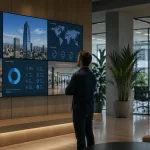
- Videowalls for real-time data monitoring.
- Training rooms with multiple displays.
- Crisis rooms with command panels.
These environments enhance workshops, training, and critical decision-making.
Modular displays that allow you to:
- Visualize up to 16 simultaneous sources.
- Operate with centralized touch control.
- Integrate with SCADA systems and BI dashboards.
Not all companies use the same video conferencing platform. To connect heterogeneous environments, you need:
The key lies in SBCs (Session Border Controllers) which translate protocols and maintain security.
Microsoft Teams Rooms vs. Zoom Rooms
| Feature |
Teams Rooms |
Zoom Rooms |
| Licensing |
Based on Microsoft 365 |
Zoom's own subscription |
| Certified hardware |
Poly, Yealink, Crestron |
Logitech, Neat, DTEN |
| UC Integration |
Native with Exchange and Teams |
Chat, Whiteboard, and Marketplace |
| Cross-VC Interoperability |
Requires CVI or dedicated gateways |
Open SDKs for third parties |
Room maintenance and management
A video project does not end with installation. You must plan for:
- Remote monitoring (telemetry, proactive alerts).
- Firmware updates according to SLAs.
- Centralized inventory and licensing.
This reduces MTTR and guarantees that rooms are always operational.
Remote monitoring and telemetry
Thanks to cloud platforms, you can receive:
- Disconnection alerts.
- Usage and call quality reports.
- Automations to restart devices on a scheduled basis.
In this regard, our NewCos solution can be highly interesting.
Unified Communications (UC) and productivity
Unified Communications combine chat, voice, video, whiteboard, and file sharing into a single ecosystem. Benefits:
- Instant response with push notifications.
- Live document co-editing.
- Centralized project history.
Integrating UC into your video conferencing strategy ensures that workflow is never interrupted.
UC Integration in video conferencing
By using Microsoft 365 or Google Workspace, your meetings link automatically with Outlook/Calendar, Teams, or Drive, eliminating manual steps and duplicated efforts.
Security best practices in video conferencing
In an environment where cybersecurity is fundamental, protecting your video meetings is just as important as image quality. Below, we detail the recommended practices to shield your virtual conferences:
Authentication and access control
To ensure that only authorized participants access the meeting, always implement multi-factor authentication (MFA). In addition to the room password, request a one-time password (OTP) via SMS or an authentication app. Also configure waiting rooms (lobbies) where the host can manually approve the entry of each attendee. This way, you prevent intruders and "zoom bombers" from disrupting your work session.
Data encryption
End-to-end encryption (E2EE) is mandatory. Make sure the platform utilizes protocols like SRTP for audio and DTLS for video, so streams cannot be intercepted or decrypted by third parties. Periodically review the provider's security audits and require certifications such as ISO 27001 or SOC 2 Type II, which corroborate compliance with international standards.
Threat and malware protection
Configure the platform to automatically block executable files in the integrated chat and restrict shared document types to PDFs, images, or presentations. Use malicious link filtering tools and apply white-list (allow-list) policies for corporate domains. Complement this with updated antivirus software on every endpoint and perform security scans on devices before they join the meeting.
Acceptable use policies
Define a clear internal policy: prohibit credential sharing, establish penalties for unauthorized recordings, and limit the creation of rooms with administrator permissions. Communicate these rules in writing to all employees and reinforce them with periodic reminders. Also implement an audit log that tracks who created or modified each meeting, as well as the configuration changes made.
Trends and future of video conferencing
Video conferencing is advancing at a breakneck pace. These are the innovations that will shape the coming years:
Augmented and virtual reality
The integration of AR and VR will allow for immersive experiences where participants "appear" in a shared 3D environment. Imagine reviewing a life-sized prototype or displaying data overlaid on your desk. Platforms like Spatial and Glue are already experimenting with collaborative sessions in corporate metaverses, merging the virtual and physical worlds.
Integration with generative AI
Artificial intelligence will move from optimizing face tracking to generating automatic meeting summaries, transcribing in multiple languages, and even suggesting decisions based on the content of the discussion. Advanced chatbots could join the room as assistants, offering real-time data, searching for relevant documents, and reminding the team of pending tasks.
Sustainability and energy efficiency
With a focus on ESG, manufacturers are developing low-power hardware and cloud platforms that optimize video load according to network capacity. "Eco-mode" solutions are emerging to reduce bitrate during backgrounds or silence, alongside recycling programs for obsolete cameras and microphones. Thus, video conferencing fosters collaboration without penalizing the planet.
Step-by-step guide to implementing video conferencing in your company
Following an orderly process ensures effective adoption without surprises. These are the key steps:
Needs assessment
Analyze how many physical rooms and remote users you have, define the type of meetings (point-to-point, group, webinars), and measure available bandwidth. Conduct interviews with stakeholders (IT, Communications, HR) to map out security requirements and compatibility with existing systems.
Provider and license selection
Compare licensing fees –per user, per room, or per event– and review certified hardware compatibility. Evaluate platform demos, request SLA reports, and study scalability based on projected growth. Don't forget to negotiate contracts that include updates and 24/7 support.
Training and user adoption
Design a training plan with video tutorials, hands-on sessions in pilot rooms, and quick-use guides. Assign internal "champions" as references for the tool and encourage its use by integrating it into daily calendars and workflows. Measure adoption with KPIs for logins, meeting times, and satisfaction surveys.
Frequently Asked Questions (FAQ)
What is video conferencing and what is it used for?
Video conferencing is a real-time communication system that allows participants to see and hear each other from a distance, ideal for meetings, training, and global collaborations.
What are the most common types of video conferencing?
– Point-to-point (2 users)
– Multipoint or group (3–50+)
– Webinars and hybrid events (massive guests)
What basic equipment do I need to get started?
– An HD camera or all-in-one bar
– A microphone with noise cancellation
– A display or projector
– A stable internet connection (>5 Mbps)
How do I choose between Zoom Rooms and Microsoft Teams Rooms?
It depends on your ecosystem: if you use Microsoft 365, Teams Rooms will be easier; if you prefer independence, Zoom Rooms offers more hardware flexibility.
What is SIP / H.323 interoperability?
They are standard protocols that allow video systems from different manufacturers to communicate with each other through gateways or CVI services.
What is the best way to manage and maintain rooms?
Implement a cloud-based monitoring platform, define update SLAs, and train an internal representative to manage licenses and hardware.
Conclusion
The Complete Guide to Video Conferencing in 2026: Platforms, Rooms, and More offers you an all-inclusive journey to understand and maximize voice and video communication. From business benefits and how to design rooms to post-installation maintenance and integration into UC ecosystems, every step is aimed at maximizing your ROI and user satisfaction.
Now it's your turn: evaluate your needs, explore our audiovisual equipment for business, plan the investment, and start enjoying more efficient, collaborative, and sustainable meetings. Want a specific recommendation for your case? Talk to a specialist.