

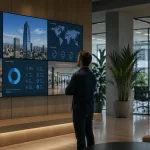




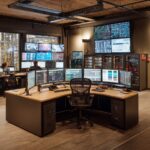






In the hybrid work model adopted by most organizations, offices now operate with teams on rotation: some employees are on-site certain days, others connect remotely, and physical spaces are shared among more people than before. In this context, meeting rooms have become one of the most contested resources in the office. With higher demand and lower availability, booking conflicts are increasingly common. That's why an efficient room booking system —one that makes the reservation process faster and friction-free— has become essential. The main reason to implement a booking system is that it centralizes the entire process, which greatly simplifies workspace management. Based on each user's permission level, teams can check the availability of every room according to its capacity and reserve it accordingly —all from a single platform. There's a common misconception that these systems complicate the process. It's quite the opposite: a good booking solution is designed to be simple and intuitive, so any employee can reserve a room and run their meetings efficiently, with no learning curve. One of the reasons this technology emerged was precisely to eliminate conflicts. The system automatically detects rooms that are already reserved and prevents double-booking. As a result, teams stay productive and don't waste time resolving overlaps or disputes over a space. There are many solutions on the market, each with its own feature set. It's worth choosing one that offers different levels of support —centralized and self-service— and, above all, strong space management features, so the tool adapts to how your organization actually works. Modern systems are versatile when it comes to offering ways to book: from a mobile app to a web platform or panels installed at each room's door. This variety of channels allows companies to operate in a more agile and efficient way. In a well-structured organization, every role has clear responsibilities. When employees have to manage bookings on their own —or when everything falls on the receptionist— productivity suffers. A booking system automates that task and frees people to focus on their actual work. Perhaps the most important benefit: when a clear usage policy exists, spaces are used in a much more structured way. The system improves each room's real occupancy, automatically releases unused reservations, and lets you use office space more efficiently. Every change or cancellation used to require a great deal of manual coordination and created confusion. With a booking system, all activity is logged in a single interface: employees no longer need to update every person when they modify a booking, because the information is always up to date and visible to everyone. A booking system solves space management, but the full experience also depends on how the room is equipped. The integration between booking software, the corporate calendar, and audiovisual technology (door availability displays, control panels, and video conferencing) is what turns a room into a truly efficient space. Want your rooms to integrate booking and technology in a single system? At Newtech Group we design and equip meeting rooms with calendar integration, availability panels, and video conferencing. Request a free demo and we'll advise you based on your space.Benefits of a Meeting Room Booking System

1. Centralized Booking Process
2. Easy to Use
3. Eliminates Booking Conflicts
4. Support and Flexibility
5. Multiple Booking Methods
6. Distributed Responsibilities
7. Better Room Utilization
8. Better Coordination Among Teams
The Booking System Is Only Part of It: The Room Matters Too